Monday, 16 July 2012

Orange and Yellow and Brown and _ _ _

We went to Messingham Sand Quarry LWT yesterday for once a glorious day, and whilst the skies blackened over for an hour it passed over and must have rained elsewhere.

Loads of Common Blue damselflies, butterflies doing what they do, flying! The only one I photographed was this Meadow Brown which I quite like on the yellow flowers. I did see a pair of Ringlets mating but too dark to photo.

There were lots of the caterpillars of the Cinnabar Moth. Caterpillars are most evident when ragwort is in full flower. The caterpillar stage lasts about 1 month during which time it undergoes 5 moults.

When fully fed the caterpillars crawl away from the plants to pupate in a dry sheltered spot such as among the debris at the base of the plants or into crevices under logs, stones and lumps of earth.

The pupal stage is prolonged lasting about 9 months, and the moths do not emerge again until the following spring.

High losses can occur in winter if pupation sites are waterlogged, as pupae cannot stand prolonged immersion in water, although they can survive considerable desiccation.
graph.


The foilage is being eaten voraciously!


Monday, 9 July 2012

Beautiful Demoiselle

I was rather surprised and delighted to see this damselfly locally at the week-end, flying low over a ditch.

The pictures were taken at the long end of my telescopic lens, not great but I wanted to post to show the beauty of these damselfly's. It's in the name!

Male 

Wings open

Female

Tuesday, 3 July 2012

Corn Bunting

On Sunday we went to Buckton Cliffs to see the Alpine Swift flying above the trig point a great bird to see. The walk from Bemprton RSPB was a little further than anticipated but about two thirds of the way I head the 'jangling keys' sound of a Corn Bunting and fortunately it was on a concrete fence post and allowed me to approach although I was shooting into the light.

The Corn Bunting has Red Status due to its dramatic population decline. It is our largest bunting a dull brown bird, paler underneath and streaky it is usually seen prominently on a fence post or wire strand singing its song. It nests in a large loose construction of coarse grasses, often in a scrape on the ground where it has 3 - 5 eggs. It eats seeds and invertebrates.

We briefly watched the very prominent Alpine Swift, never getting to the trig point as there was no need with it flying overhead, we beat a hasty retreat as the black clouds rolled in once more and made it back with only a few spots of rain falling on us.


Record shot of Alpine Swift


The gathering on trig point Buckton Cliffs


The gathering clouds above trig point!

Tuesday, 26 June 2012

Difficult subjects - Snake in the grass

Highlight of Sunday's visit to Top Hill Low was three basking grass snakes. We were able to get right up to them presumably because we were on paving flags and they were on the adjacent grass bank. Great to get so close but very difficult to focus. One moved off it appeared under the flags beneath our very feet whilst I tried to get something decent of the remaining pair.

The other highlight was a first summer (or juvenile?) Little Gull. The mating Advocets have now had chicks, we saw three I believe this is a reserve first, who would have thought this a few years ago. I hope the chicks survive.


Tuesday, 19 June 2012

Partridge Family

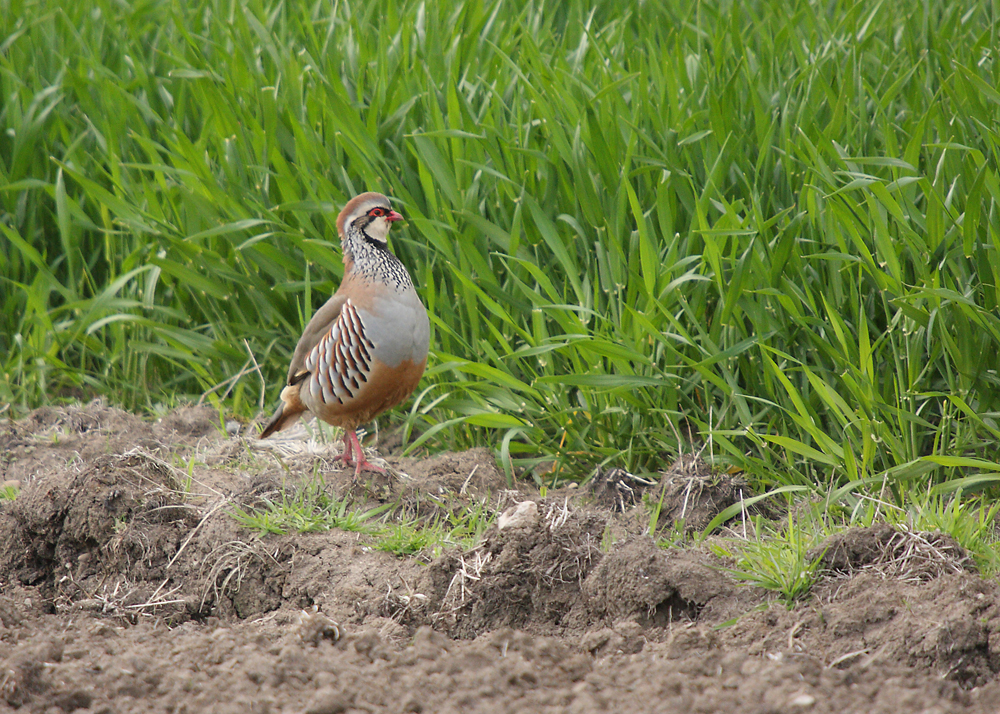
I have never got many pictures of partridges even though we have lots of Red Legged around home. A few pictures as they run off, take flight, they are very skittish. I have seen few Grey's before but this year I have seen a few local close to home, this feels new the game keepers must be leaving them, introducing them I am not sure. On Sunday I got a half decent picture of a Grey Partridge in a tilled field near Fraisthorpe, Bridlington.

Oh, not that lot!


Shot with Canon 7D, seemed quite a bright picture on a grey afternoon.

The following shots were shot a few weeks ago with my 40D, one of a couple of sessions photographing Red Legged Partridges this year, never quite close enough but things are looking up!


Wednesday, 6 June 2012

Three S's, Stoat, Shrike & Sky Lark

What a great week-end, yes I have to confess the t.v. coverage of the Diamond Jubilee was good and it was a really special event but wildlife wise I had a good time too.
I have always wanted to photograph a Stoat, I once thought I had found a Stoat's residence (don't know the proper name) but a) I didn't follow this up enough and b) never saw a Stoat there again! I have seen a dash across a road or track a few times and the give away black tail tip but alas no photos. My luck finally changed on Saturday afternoon when on my travels I saw a Stoat dart across a lane. Swiftly pulling up I sat for a few moments and I could just see a little face on the top of a dry stone wall, yes a youngster. I sat and waited a few moments and yes the adult came back. What a beautie and it got interested in that lens sticking out a black car, looking and getting closer. The shots are hand held but what a treat. 
On Monday we went across to Flamborough for the reported Red Backed Shrike lovely bird, mostly low down on bushes or barbed wire strands. This is a stonking male bird, always distant and awkward for photography in my two hours there.
Skylarks were in the gorse field that contained the shrike, I tried some flight shots as it hovered above and quite close. This is where I am seeing the benefit of my 7D. You will see many better shots but now with the auto focus options and speed of shooting I am getting shots!
I hoped to type this next to the appropriate shots but Blogger is difficult to control at times!


Saturday, 2 June 2012

2 Fly's and Goosander Brood

We had a great day visiting Bolton Abbey yesterday with target bird of Pied Flycatcher and maybe Redstart.

One of the first birds we saw was a Spotted Flycatcher on the fence of the Priory and catching insects. Not a bad start in the first few minutes and a first this year. We do have some locally at Hilla Green and I hope to try my luck.

We had a smashing walk along the west bank of the river and I got a quick glimpse of a Pied Flycatcher with insects in its bill before it flew off. It was the only one we saw all day, I thought we might see one or two on the return leg along the east side but alas no.

We did see at lease two more Spotted Fly's maybe three catching insects in trees right on the river bank.

The definite highlight though was female Goosander with it's brood of 11 (yes, eleven) chicks. Tiny dots that moved fastly and two got at one point on mum's back. I read that the Goosander lays 8 -11 eggs, so this seems almost the maximum number, a brilliant sight. I wonder how many will survive.

Higher up the river we saw another Goosander with three older youngsters.